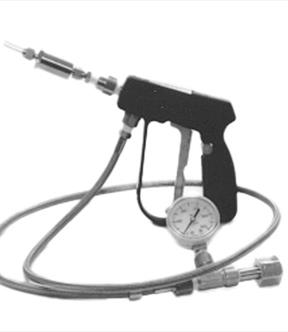


The CO2 Snow Cleaning process removes particles of all sizes, from visible down to 3-5 nanometers. At the same time, it removes hydrocarbon-based contamination and organic residues. Carbon dioxide snow cleaning is non-destructive, nonabrasive, residue-free, and environmentally friendly - there is no chemical waste. The cleaning process is based upon the controlled expansion of either liquid or gaseous carbon dioxide. This expansion leads to the nucleation of small dry ice particles and a high-velocity carrier gas stream. Upon impact with a surface, the dry ice removes particles of all sizes by momentum transfer, and hydrocarbons and organics via a transient solvent or freeze-fracture mechanism. The high-velocity gas blows the contaminants away.
Carbon Dioxide Snow Cleaning can be used for initial or final cleaning, and for numerous critical and noncritical applications, including semiconductor, disk drive, research, vacuum technologies, surface science, surface analysis, optical, medical, analytical instruments, telescopes and art conservation.
Applications:
- Contamination removal from metals, ceramics, polymers, and glasses
- Particle and stain removal from Si, InP, and GaAs wafers
- Cleaning optics, i.e., coated lenses, laser, IR and UV optics, diamond-turned optics
- Sample preparation before surface analysis (Auger, XPS, SIMS) and AFM
- Basic surface science studies
- General laboratory, production, and cleanroom cleaning
- Substrate preparation
- Manufacturing of many metal and ceramic parts and assemblies
- Cleaning vacuum system components, bellows, electron and ion optics
- Removing particles from microelectronic and hybrid circuits
- Art cleaning
- Cleaning telescope mirrors
More informatio is available at www.co2clean.com or get in touch for costs and lead times.